

Lately, it feels like we, as football fans, are incapable - or unwilling - to separate the talents of individual players without viewing them through the sceptical lens of trophies won as part of a wider team.
A good individual who contributes over and above expectations in a team that wins less than expected will always be judged harsher than a lesser player who contributed to a wildly successful dynasty at one club. The truth, as always, lies somewhere in the middle.
Less capable teammates will inevitably hinder a few exceptional footballers in the modern game if the team’s overall strategy fails to leverage the former’s strengths and mitigate the latter’s weaknesses.
The midfield area of any team plays a pivotal role in achieving the delicate balance between individual talents and team performance. It’s this area of the pitch where the most crucial battles are contested.
In the ever-evolving football world, individual player roles have undergone significant changes. Once a specialist role, the central midfielder has seen a sizeable shift. Players like Kevin De Bruyne and John Stones, who performed in other areas of the pitch a decade ago, now find themselves in the middle of the pitch due to tactical advancements. With so much flux and ever-changing in-possession and out-of-possession structures, consistency of roles from team to team can be as hard to come by as balance.
“You have to know the past to understand the present.”
- Carl Sagan
So, what is the perfect midfield balance? How do you find it? Is there only one way to skin this particular cat? No, of course not.
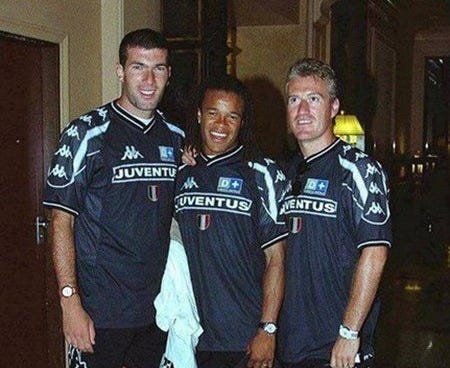
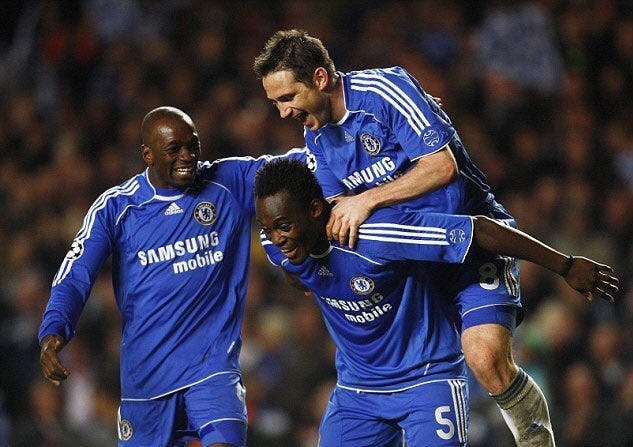
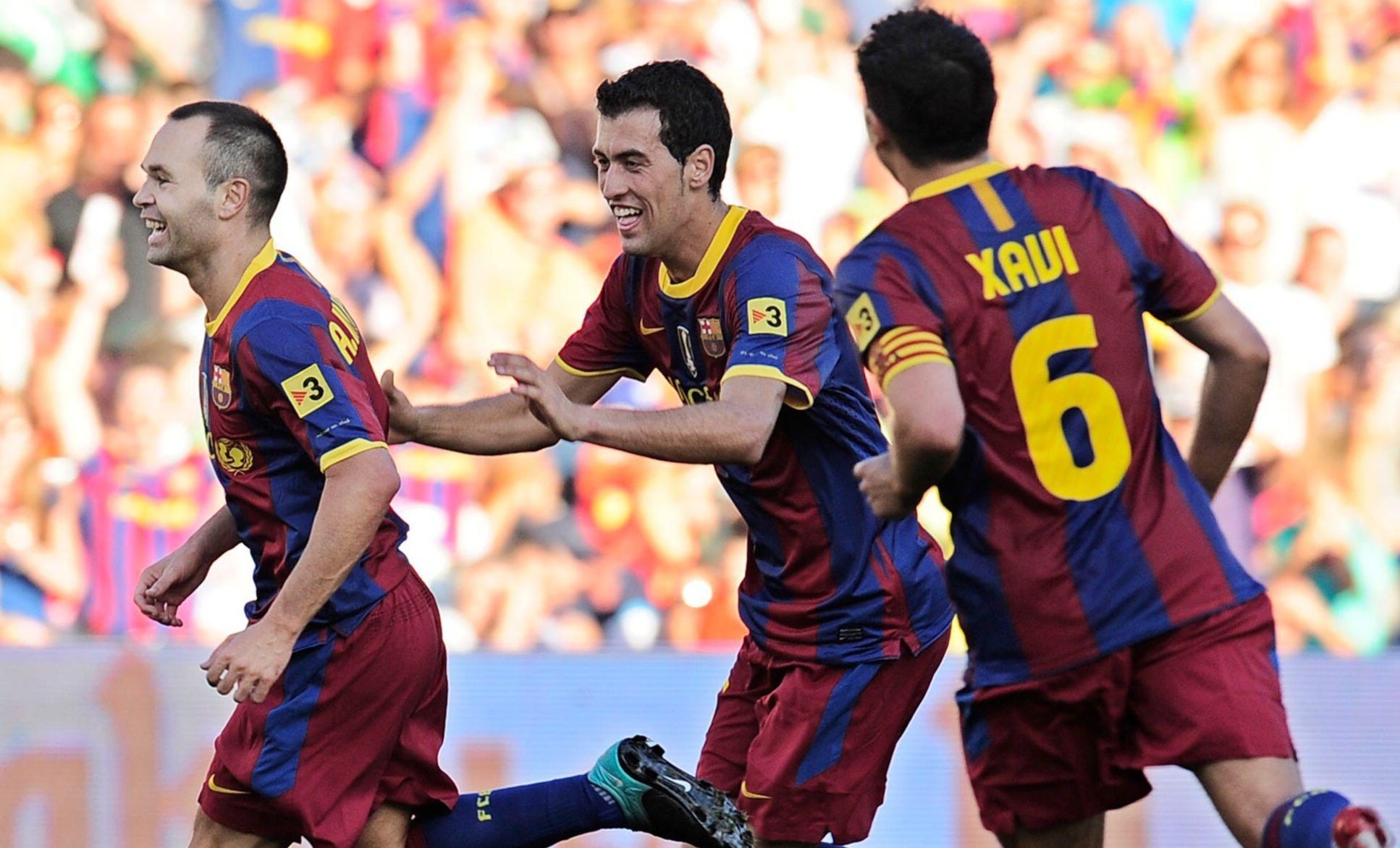
It’s true that one player in each of the above midfield threes could be loosely assigned to the number six, number eight, and number ten positions. In reality, these are three very different midfield combinations in three very different leagues in three very different eras. But they dovetailed perfectly as the core of three successful—but very different—football teams.
Didier Deschamps, Claude Makelele and Sergio Busquets were all midfielders who did their best work at the base of a midfield. Deschamps was famously referred to by Eric Cantona as ‘the water carrier’ in a way that inferred he was of less importance or talent than the more creative players. This was an era where multiple roles or ways of playing the same positions had yet to be defined - but Deschamps role indeed was that of a classic defensive midfielder, who won the ball back and passed it on to others to attack.
Claude Makelele’s role at Madrid could be viewed as akin to that of Jon Snow in that famous ‘Battle of the Bastards’ scene in Game of Thrones. A one-man defensive unit trying to deal with a tidal wave of attackers whilst his other, more illustrious colleagues got on with the fun stuff further up the field. Undoubtedly, this role was primarily defensive, but contribution in the attacking phase was still encouraged. Makelele was responsible for receiving the ball in the build-up, inviting the opposition to press him and thus creating spaces between the lines where he could slide passes through to the attackers.
At Chelsea, he doubled down on the defensive side of the role with new coach Jose Mourinho joining in 2004. Moving to a three-man midfield, he was undoubtedly the anchor to free up Lampard - and later Essien - to become box-to-box midfielders
Adept at covering the new wave of attacking fullbacks, he was used to covering large distances and tasked with winning the ball back during counterattacks. This allowed Chelsea to be more adventurous in their attacking play, safe in the knowledge they had Makelele and two centre-halves behind the ball and keeping the back door locked. He was so successful at this that he’s a rare example of a role becoming synonymous with a player - thus, the ‘Makelele Role’ was born.
Sergio Busquets was a different type again to both Deschamps and Makelele. The phrase ‘press resistant’ could have been created to explain Busquet’s main strengths on the football pitch succinctly. Not particularly quick nor a player who sought to break the lines frequently with risky passes, Busquets could have been expected to carry on that tradition of a standard defensive midfielder in a three-man midfield. A focus of Busquets play in possession was to drop in between both centre-backs to create a three-man defence in possession - which had two main benefits.
Doing this, would bait the opposition into pressing to win the ball back deep in Barcelona’s half, but as above, leaving spaces in their defensive structure to be exploited. Dropping deep to form that three-man defence also allowed Barcelona’s rampaging full-backs to press high and wide to stretch play, thus giving a talented passer more options to pass to in advanced areas. Busquets role was all about ball retention and manipulation of space, which nicely sums up Barcelona’s playing philosophy at this time. But performing that role is one thing; balancing it with players who can receive those passes in tight spaces and damage the opposition is quite another.
That’s where Xavi and Andres Iniesta came into play. The quote above is from Sir Alex Ferguson before Barcelona’s victory over Manchester United in the 2009 Champions League Final.
“They get you on that carousel and they make you dizzy with their passing”
The pair were a constant whirlwind of energy. Pass, move, pass, move. On and on it went until the opposition left just a split second of space for a pass to make its way through into the penalty area and the inevitable Messi goal. That was all they needed. Busquets loads the chamber with a pass to beat the pressure of the opposition, Xavi uses all of his nous and playmaking ability to aim the gun, and Iniesta dances between the lines and halfspaces before firing the bullet.
Michael Essien and Frank Lampard arguably performed a more ‘traditional’ role within Mourinho’s early Chelsea setups, but the broad tasks remained the same. Essien carries the ball forward at pace, committing midfielders to attempt to tackle. The ball is funnelled out wide for a wide players who then also looks to play a dangerous pass into the box. Lampard arrives late in the box to slot home a fantastic goal. Players working together to accentuate their individual strengths for the team.
Similarly, it would not be outlandish to state that Michael Essien and Edgar Davids had a similar style of play. A lot of energy and physical aggression but married perfectly with a high technical quality. The difference here would be that between Zinedine Zidane and Frank Lampard. If Lampard was deemed an attacking number eight who would burst from deep, Zizou at this time was undoubtedly a number ten of extremely high quality. Not so much with the defensive work, but lethal in that central area in front of the penalty box. It stands to reason, then, that Davids & Deschamps would both play less glamorous roles and create a more solid base behind them to make up for that potential gap in the system that teams could exploit.
These are just three possible midfield combinations - and three of the best in the last 30 years - but there are many more. However, when managers decide to set up a midfield unit, they might first ask themselves what they are trying to achieve. Do they have a lethal strike force and rampaging fullbacks like Liverpool under Jurgen Klopp? Does it make sense in that system that the primary role of the midfield is to support that whilst providing defensive cover?
Are they a lesser team in their league who may not dominate possession? Would a back five with three shuttlers in the middle make sense to keep things tight and try to hit on the break?
If you aren’t blessed with talented attackers, a system reliant on inferior wide players or players who aren’t best suited to creating opportunities for themselves out of nothing probably isn’t a long-term solution.
This is where a manager’s playing style should predominantly align with the challenges a team might face in most games. Equally important is that the same style of play be suited to the strengths and weaknesses of the squad of players he has available.
It’s all about that balance.
Hi all, today’s post at Sing Palestine Vivra is a tribute to the soccer fans (and player) around the world, who have publicly displayed support for the Palestinian people. The fans are stepping up, but where are the players? And we need to hear from other sports -cricket, field hockey, tennis, volleyball, table tennis, basketball, baseball, rugby, golf, American football and ice hockey.
https://open.substack.com/pub/jeffhoulahan/p/sounds-for-palestine-day-13?r=604ds6&utm_campaign=post&utm_medium=web&showWelcomeOnShare=true
We’ve started Sing Palestine Vivra to encourage people to make public demonstrations of support for the people of Palestine. Eventually, we hope to be able to use Sing Palestine Vivra to organize large scale campaigns of public demonstrations of support for Palestinians.
The substack Sing Palestine Vivra will never accept donations or paid subscriptions.
In Solidarity and with Hand to Heart, Palestine Vivra